Hercynian landscape
The birth of a Hercynian landscape
The Yon watershed between heaven and earth
Project research at ENSP of Versailles
Year : 2021
Territory : Yon river satershed, Bocage Vendéen (FR)
The interest in geology as a structural basis of the environment is the basis of reflection for this project. Indeed, the geology of the Vendée is inscribed between two particular geological formations which are the Armorican massif and the Aquitaine basin. Geologic forces in action produced specific volcanic formations during the Hercynian cycle (there are about 400 to 250 million years ago) that one finds at the center of the department. They are named Granite Complex of the Bas-bocage. These formations are surrounded by schistose rocks that formed at the same time as the granite massifs. The term 'Hercynian' therefore refers to the specific geological base of the center of the Vendée.
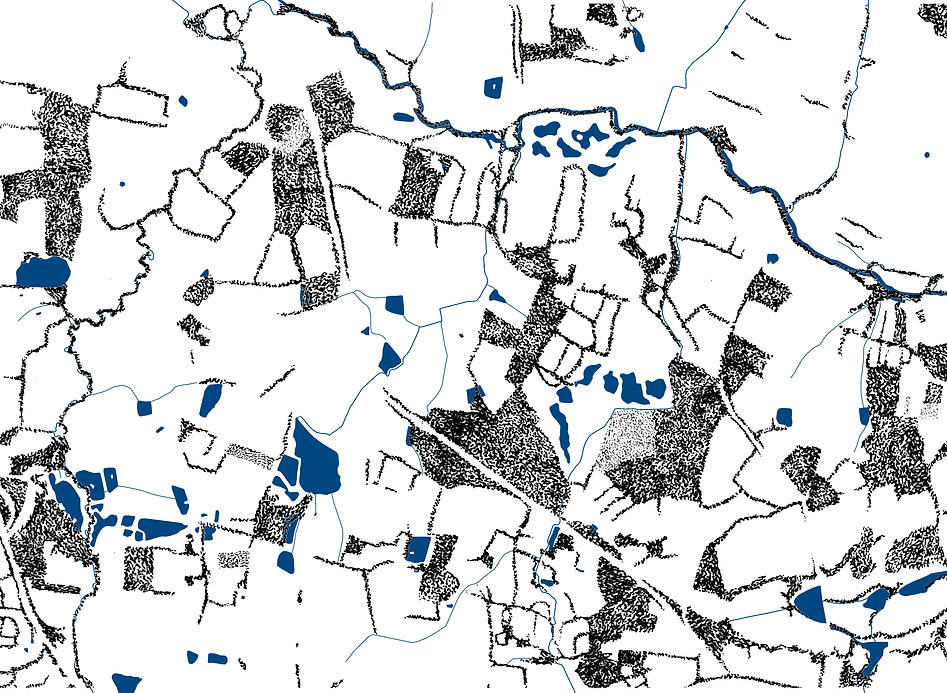
The bedrock of the base is an impermeable rock and the slope is relatively low, so water has difficulty escaping. Stored in wetlands by the irregularities of the soil, this water supplies multiple sources at the origin of a dense hydrographic profile.
As a result, the majority of drinking water comes from surface waters (90%) and controlling both the quantity and quality of this water is essential, especially since climate change is disrupting climatic conditions and the resulting amount of rain. In La Roche-sur-Yon, the capital of the department, average rainfall is 800mm/year with minimum and maximum amounts that are more and more irregular as in 2001 with 1521.6mm of water or in 2016 with 543.5mm of rain. Water management is a significant problem since it impacts not only drinking water reserves but also those for agricultural irrigation.
The watershed of the Yon river is located in the center of the county, crosses the different granite massifs and contains at its heart the urban area of La Roche-sur-Yon. It is a geographical entity highlighting the issues related to the management of the water reserve and the challenges faced by the entire Vendée bocage
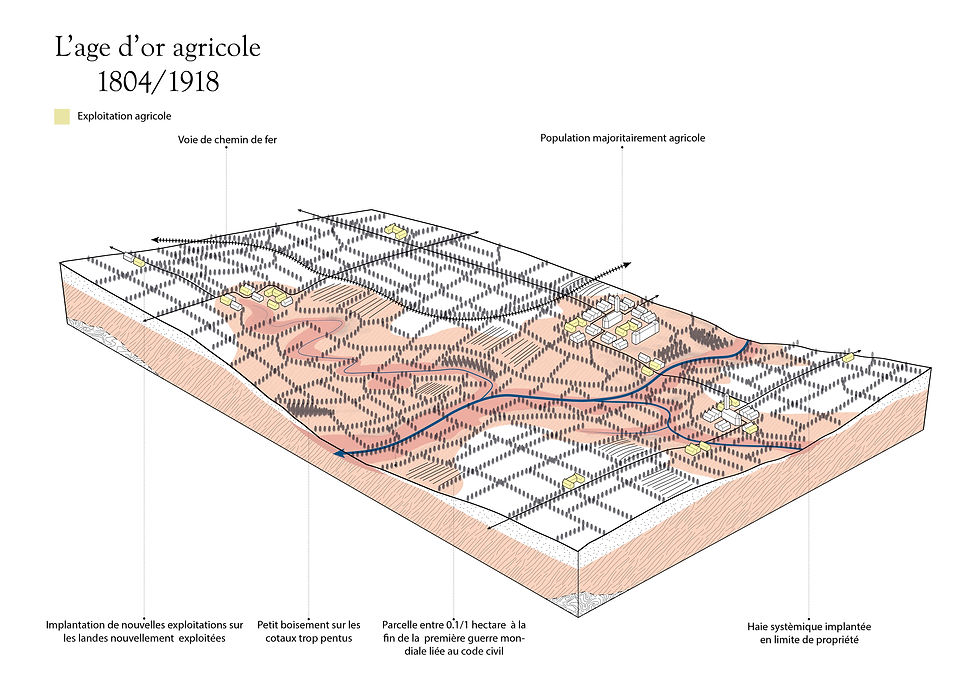
To create this Hercynian landscape, it is necessary to start by transforming the smallest units of the territory, which are farms and villages/hamlets. Indeed, the Vendée landscape has mostly been built from the base with consequences on a larger scale later on like the implantation of hedges along the edges of plots which formed the bocage landscape so typical of this territory.
A precise study of the soils on these farms reveals the different types of soils and their characteristics that are necessary to know before proposing a new landscape configuration through the implementation of agroforestry systems and the reinterpretation of the hedges already presents.
The plant dynamics already present are oriented so that they can serve the project and become an integral part of the basic concept.
The villages, which are arranged on the hillsides, are transitional spaces and function as pivots between the different spaces that are the plateaus where the agroforestry plots are located and the meadows-down where the watercourses and the ponds develop in a more open space. This configuration restores a central position of dwellings in this territory and gives responsibility to the inhabitants in this landscape where water evolves in its different forms. The safeguarding, implementation and reinforcement of hedgerows, ditches, valleys and paths in and around hamlets and municipalities will allow for the reconnection of plateaus to meadows.
By the arrangement of this landscape as such, there is an increase in the contrast between plateaus and near-low, which accentuates the natural geography over the entire slope. The uniform sensation of the bocage gives way to a hierarchy of space and a diversification of atmospheres related to the Hercynian geological base.
In order for this system to be accepted by the population and to gradually integrate into the cultural landscape that is the bocage, it is necessary to be gradual in its implementation and also give time to the different economic actors (farmers, cooperatives, industrialists, distribution networks...) to create the necessary economical sectors to make this system viable.